
HSE Management in Nigeria’s Oil & Gas Industry: The Complete Guide
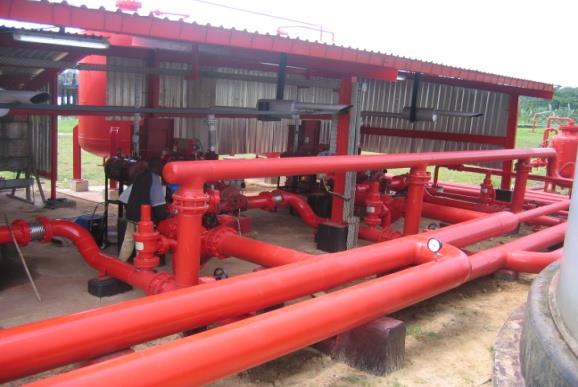 Fire-fighting infrastructure and safety systems on a CASIL project site.
Health, Safety, and Environment (HSE) management is not a document sitting in a folder — it is the set of practices that decide whether people go home safely at the end of every shift on an oil and gas construction site. Nigeria’s oil and gas sector combines high-hazard activities — hot work, confined spaces, lifting, work at height, hydrocarbon handling — with a regulatory environment, community context, and environmental sensitivity (particularly in the Niger Delta) that make HSE management a genuinely technical discipline in its own right. This guide walks through what effective HSE management actually looks like on a real project site.
In This Guide
1. The Nigerian Regulatory Framework
HSE management on a Nigerian oil and gas project doesn’t operate in isolation — it sits inside a defined regulatory structure. The Nigerian Upstream Petroleum Regulatory Commission (NUPRC), successor to the Department of Petroleum Resources (DPR), sets and enforces safety and environmental requirements for upstream oil and gas operations, including HSE case submissions, permit-to-work standards, and incident reporting obligations. The National Environmental Standards and Regulations Enforcement Agency (NESREA) governs environmental compliance more broadly, including waste management, effluent discharge, and environmental impact assessment requirements. Beyond sector-specific regulation, the Factories Act sets baseline occupational health and safety obligations for industrial premises, and the Oil Pipelines Act governs pipeline right-of-way and safety requirements specifically.
Internationally recognized management system standards — most notably ISO 9001 for quality management, often paired with occupational health and safety management frameworks — are widely adopted by contractors and operators to give project HSE programs a structured, auditable basis that aligns with both local regulation and the expectations of international operators and joint venture partners.
2. The CASHES Framework
Many operators and contractors in the Nigerian oil and gas space structure their HSE programs around the CASHES framework — Community Affairs, Safety, Health, Environment, and Security — which recognizes that risk on a Nigerian project site extends beyond the immediate worksite to the surrounding community and the security context the project operates in.
We’ve covered this framework in detail in our dedicated guide — Understanding the CASHES Framework — but the core idea is that treating these five areas as one integrated program, rather than five separate silos, is what produces a genuinely safe and sustainable project.
3. Hazard Identification: HEMP and JHA
Good HSE management starts before any work begins, with a structured process for identifying what could go wrong and deciding how to control it.
Hazard and Effect Management Process (HEMP)
HEMP is a systematic, project-level process for identifying hazards associated with a scope of work, assessing the potential effects (to people, environment, assets, and reputation), and defining the controls — engineering, procedural, and PPE — needed to reduce risk to an acceptable level before work is authorized. It is typically documented early in project planning and revisited whenever the scope changes.
Job Hazard Analysis (JHA)
Where HEMP operates at the project or activity-category level, a Job Hazard Analysis breaks a specific task down step by step, identifying the hazards present at each step and the control measure for each — before the crew starts work. A JHA for a pipeline tie-in weld, for example, will separately address the hazards of hot work, confined space proximity, working near a live line, and manual handling of equipment, with a specific control assigned to each.
 A toolbox talk and JHA review before work begins is standard practice on every shift.
4. Permit-to-Work Systems
A permit-to-work (PTW) system is the formal authorization process that confirms hazards have been identified, controls are in place, and named individuals are accountable before higher-risk work starts. Common permit categories on an oil and gas construction site include:
- Hot Work — welding, cutting, grinding, or any activity producing a spark or flame near flammable materials or atmospheres
- Confined Space Entry — entry into tanks, vessels, trenches over a certain depth, or any space with restricted entry/exit and potential for hazardous atmosphere
- Electrical Isolation — lockout/tagout procedures before work on or near electrical equipment
- Work at Height — any work above a defined height threshold requiring fall protection
- Excavation — trenching and ground-breaking work, which carries its own risks of collapse and underground utility strikes
- Lifting Operations — crane and rigging work, requiring a lift plan and a competent appointed person
Each permit has a defined validity period, requires sign-off from an authorized issuer after verifying site conditions, and is closed out formally once the work is complete — a discipline that prevents work continuing under conditions that have since changed (a gas test that’s gone stale, or a nearby activity that’s introduced a new hazard).
5. PPE and Site Discipline
Personal protective equipment is the last line of defense — after elimination, substitution, engineering controls, and procedural controls have already reduced the risk as far as reasonably practicable — but it still has to be right for the task. Common standards referenced for PPE on oil and gas sites include BS EN 397 for industrial safety helmets, BS EN 166 for eye protection, BS EN 388 for protective gloves against mechanical risks, BS EN ISO 20345:2011 for safety footwear, and flame-resistant coveralls to NFPA 2112 or BS EN ISO 11612 standards for personnel exposed to flash-fire risk, with respiratory protection selected to BS EN 141 or equivalent where atmospheric hazards are present.
 PPE selection is matched to the specific hazard, not applied as a generic blanket rule.
PPE alone doesn’t create a safe site — site discipline does. That means PPE actually being worn correctly, equipment being inspected before use rather than assumed serviceable, and a working culture where a supervisor or a peer can stop a task on the spot if something looks wrong, without that being treated as an inconvenience.
6. Incident Reporting and Investigation
- Immediate responseMake the area safe, provide first aid or medical response as needed, and prevent escalation before anything else.
- NotificationReport the incident through the defined chain — site supervisor, HSE officer, and project management — within the timeframe set by the project’s HSE plan.
- Preservation of evidenceSecure the scene and record conditions (photographs, witness statements, equipment status) before anything is moved or cleaned up, unless doing so would create further risk.
- InvestigationA structured investigation identifies not just what happened, but the underlying root causes — often multiple contributing factors rather than a single one.
- Corrective actionFindings are translated into specific, assigned corrective actions with deadlines, and closure is tracked rather than left open indefinitely.
- Learning and communicationLessons learned are shared across the project — and, where relevant, across other sites — so the same root cause doesn’t produce a repeat incident elsewhere.
| Category | What It Covers |
|---|---|
| Near miss | An event that could have caused harm but didn’t — reported to catch weaknesses before they cause an actual incident |
| First aid case | Minor injury treated on site with no further medical treatment required |
| Medical treatment case | Injury requiring treatment beyond first aid, without lost time |
| Lost time incident | Injury resulting in the person being unable to return to work the following shift |
| Environmental incident | Any uncontrolled release or environmental impact, however minor |
7. Building a Genuine Safety Culture
Procedures and permits set the floor for safe work — culture determines whether people actually follow them when no one is watching. A genuine safety culture on an oil and gas project shows up in specific, observable ways: workers stopping work themselves when something isn’t right, without waiting for a supervisor’s instruction; near misses actually getting reported rather than quietly ignored; toolbox talks that are a real conversation about the day’s specific risks rather than a box-ticking exercise; and leadership visibly participating in site walks and safety reviews rather than treating HSE as someone else’s department.
The Bottom Line
HSE management works when it’s built into how work actually gets planned and done — HEMP and JHA before the task starts, a permit system that’s respected rather than routed around, PPE matched to the real hazard, and an incident reporting culture that treats a near miss as valuable information rather than a problem to hide. None of it replaces good engineering and competent people — it’s what makes sure that competence is applied safely, every shift.
Need an HSE-Led Delivery Partner?
CASIL builds Health, Safety & Environment management into every stage of project delivery — from HEMP and permit-to-work through incident reporting and site culture. Talk to us about your project’s HSE requirements.