
Storage Tank Construction, Inspection & Rehabilitation in Nigeria’s Oil & Gas Industry
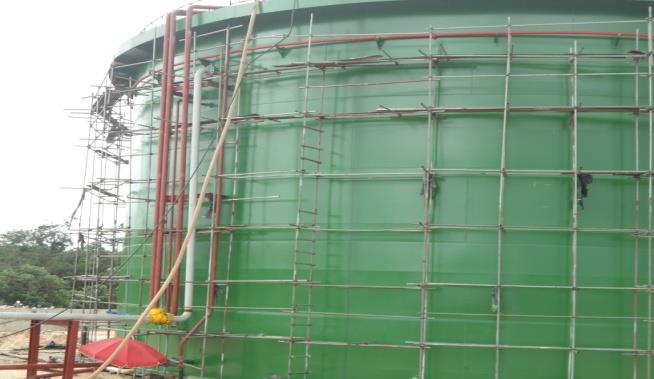 Storage tank construction in progress on a CASIL project site.
Storage tanks sit at the center of nearly every oil and gas facility — holding crude, refined products, produced water, or firewater reserves. A tank that is designed, built, and inspected correctly can serve a facility safely for its full design life; one built to a shortcut, or left uninspected for years, becomes a leak, a fire risk, or an environmental incident waiting to happen. This guide covers what goes into building a storage tank properly, and what it takes to keep an aging tank safe through inspection and rehabilitation — the way engineering teams approach it on real Nigerian oil and gas sites.
In This Guide
1. Tank Design and Applicable Standards
Storage tank design starts with the fluid to be stored, the required capacity, and the site conditions — soil bearing capacity, seismic considerations where relevant, and prevailing wind and rainfall loads for the location. Above-ground welded steel storage tanks for petroleum products are most commonly designed to API 650 (Welded Tanks for Oil Storage), which sets requirements for shell plate thickness, roof type (fixed cone roof, floating roof, or dome), nozzle placement, and allowable design stresses. Where a tank is being modified, repaired, or assessed after years in service, API 653 (Tank Inspection, Repair, Alteration, and Reconstruction) governs. Fire and safety design references NFPA 30 (Flammable and Combustible Liquids Code) for spacing, containment (bund/dyke) sizing, and venting requirements, while local approvals go through NUPRC and, where applicable, state environmental authorities and the Fire Service.
Tank capacity, shell course thickness, and roof type are decided together — a larger-diameter tank needs thicker lower shell courses to contain the same hydrostatic head, and floating-roof tanks (used to reduce vapor loss on volatile products) carry different structural and safety requirements than fixed-roof tanks used for less volatile stock.
2. Site Preparation and Foundation
A tank foundation has to carry the full weight of the tank and its contents once filled — for a large tank, this can run into thousands of tonnes — without settling unevenly. Site preparation starts with a geotechnical assessment of the soil, followed by excavation, compaction, and construction of the foundation itself, which is typically a ring-wall foundation (a reinforced concrete ring supporting the tank shell, with a compacted sand or gravel pad inside) or, for smaller tanks, a full concrete slab.
 Tank foundations are engineered to carry the full hydrostatic load of the tank once filled.
Foundation settlement is checked before, during, and after construction. A survey grid is set up around the ring wall, and settlement readings are taken as the tank is built and again during the water/hydrostatic test, since uneven settlement at that stage — while there’s still time to correct it — is far cheaper to address than after the tank has been in service with product for years.
3. Shell and Roof Construction
Tank shells are built up in horizontal courses — rings of steel plate welded together — from the bottom upward, with the thickest plate at the bottom course (where hydrostatic pressure is greatest) tapering to thinner plate at the top. Two main erection methods are used in practice:
- Conventional (stick-built) erection: the bottom plates are laid and welded first, then shell courses are erected and welded course by course, with the roof structure built and plated at the top once the shell is complete. This method is well suited to sites with limited lifting capacity or awkward access.
- Jacking (or “float-up”) erection: the roof is built at ground level first, then progressively jacked upward as each shell course is welded in beneath it — reducing the amount of work done at height, which has safety advantages on larger tanks.
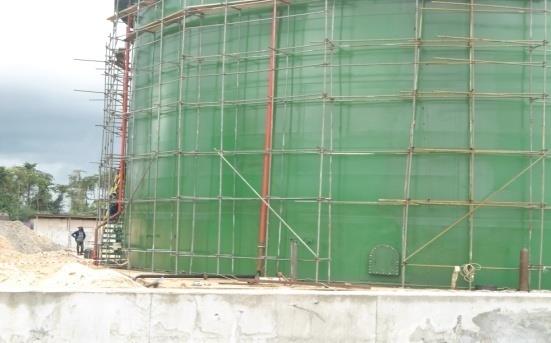 Shell plate erection and welding, course by course, from the bottom upward.
All shell, bottom, and roof welds are carried out by qualified welders to an approved welding procedure specification, and the welds are inspected — commonly by radiography on shell butt welds and vacuum-box testing (a soap-film test under a sealed vacuum box) on the tank bottom, which is highly effective at finding pinhole leaks in the floor plate welds that a tank will sit on for the rest of its service life.
4. Lining, Coating, and Corrosion Protection
A steel tank’s biggest long-term threat is corrosion — both internal (from the stored product and any water that settles at the tank bottom) and external (from weather exposure). External surfaces are typically shot-blasted to the specified surface profile and coated with a multi-coat epoxy or polyurethane system, chosen for UV and weathering resistance. Internal lining depends on the product stored — tanks holding water, produced water, or certain fuel grades often receive an internal epoxy lining system, while some crude and fuel storage tanks rely on cathodic protection (sacrificial anodes or an impressed-current system) on the tank bottom in addition to, or instead of, a full internal coating. Coating thickness is checked at each stage with a dry-film thickness (DFT) gauge against the specified range, and holiday (pinhole) testing confirms there are no gaps in coverage before the tank is put into service.
5. Testing and Commissioning
- Tank bottom vacuum-box testingBottom plate welds are tested with a vacuum box and soap solution to detect any leak path before the tank is filled with product.
- Hydrostatic (water) testThe tank is filled with water in stages, with settlement and shell plumbness readings taken at each stage, to prove the completed structure can safely hold the design liquid load.
- Settlement verificationFoundation settlement readings from the water test are compared against the allowable limits in the design code; any significant or uneven settlement is investigated and corrected before the tank is accepted.
- Dewatering and dryingOnce the water test is passed, the tank is drained, cleaned, and dried in preparation for internal lining (if specified) or product introduction.
- Final inspection and handoverA final walk-down inspection confirms nozzles, vents, gauges, fire-fighting connections, and earthing/bonding are correctly installed before the tank is handed over and commissioned into service.
Why the Water Test Matters
The hydrostatic test isn’t just a formality — it’s the only point before the tank goes into service where the foundation’s real behavior under full load can be observed and, if necessary, corrected. A tank that passes its water test with acceptable, even settlement gives real confidence in its long-term performance.
6. In-Service Inspection and API 653 Rehabilitation
A storage tank does not stop needing engineering attention once it is commissioned. Under API 653, in-service tanks are subject to routine external inspection (typically annual, by tank operating personnel) and periodic formal inspections by a certified tank inspector, with the interval depending on the tank’s corrosion rate history, product stored, and prior inspection findings.
What an API 653 Inspection Covers
- External visual inspection of the shell, roof, foundation, and appurtenances for signs of corrosion, coating failure, or settlement
- Shell thickness measurement using ultrasonic testing (UT) to track corrosion rates against the original design thickness
- Tank bottom inspection — often using magnetic flux leakage (MFL) scanning while the tank remains in service, or a full internal inspection with the tank taken out of service, cleaned, and entered
- Roof and vent inspection, including floating-roof seal condition where applicable
- Foundation and settlement survey
 Access platforms and stairways allow inspectors to reach shell, roof, and nozzle areas safely.
Repair and Rehabilitation
Where inspection finds shell or bottom plate thickness has reduced below the minimum allowable, or coating has failed, API 653 sets out engineered repair options — from lap-welded bottom patch plates, to partial or full bottom replacement, to shell plate replacement — each carried out to a qualified repair procedure with post-repair NDT and, where the repair is significant, a re-test before the tank is returned to service. Older tanks that have been well maintained and properly inspected can often be rehabilitated and requalified for continued service rather than being replaced outright, which is frequently the more economical path for an operator.
7. HSE Throughout the Process
Tank construction and inspection both involve elevated-risk activities: work at height on the shell and roof, confined-space entry for internal inspection or repair, hot work (welding) close to product storage areas, and heavy lifting during erection. A Job Hazard Analysis and permit-to-work process governs each of these — confined-space entry in particular requires atmospheric gas testing, continuous monitoring, and a trained standby person before anyone enters a tank that has held hydrocarbon product, even after cleaning and purging. Fall protection is mandatory for shell and roof work, and hot work permits require gas-free certification and fire-watch coverage on or near live tank farms. This discipline reflects the same CASHES approach — Community Affairs, Safety, Health, Environment, Security — that runs through every CASIL project, covered in more depth in our CASHES framework guide.
| Activity | Primary Hazard | Key Control |
|---|---|---|
| Shell/roof erection | Work at height, falling objects | Fall arrest systems, exclusion zones below lifts |
| Welding | Hot work near flammable atmosphere | Gas-free certificate, hot work permit, fire watch |
| Internal inspection | Confined space, residual vapors | Gas testing, continuous monitoring, standby person |
| Coating application | Solvent vapors, confined space | Forced ventilation, respiratory protection |
The Bottom Line
A storage tank’s safety record over 20 or 30 years of service is set by three things: a foundation and shell built to the design code, welds and coatings inspected and verified before the tank ever holds product, and a disciplined inspection program afterward that catches corrosion and settlement while they’re still repairable.
Building or Inspecting a Storage Tank?
CASIL’s engineering team handles tank construction, coating, testing, and API 653 inspection and rehabilitation, with HSE built into every stage. Talk to us about your project scope.